Body-oriented coaching and nervous-system support.
For when insight alone hasn't shifted how stress is experienced, and shows up in your body.

Registered nutritional therapist · MSc · Body oriented coaching · training in Psychoneuroimmunology
A body's response always makes sense.
Our systems are doing something for a reason, even when that reason has long passed.
You can understand exactly why you feel anxious or exhausted. You can name the patterns, listen to the podcasts, journal, and do all the things you know are supposed to help, yet still feel like your body hasn’t got the memo.
For the last nine years I have worked the way I was trained to work. Looking at symptoms, understanding the mechanisms underneath them, building careful plans. People got better, and they still do.
But I also sat with people who had done everything right. The clean diet, the sleep routine, the supplements, the testing. They would improve, and then a hard week, would bring it all back. A body under sustained load responds differently to the same input. So I stopped working only with what goes in, and started working with the state itself. It is slower, it happens in the body, and it asks a different question: not what happened to you, but what you are still responding to, and what you have not been able to come out of..and though I spent years asking what was going into a body. Over time I came to think that was only half the question. The other half is what state a body is in. So the question I ask now is not what happened to someone, but what their body is still responding to, and what it has not been able to come out of.
What struck me most was that these people usually understood their stress incredibly well. They could tell me where it came from, why it made sense, and how their patterns had developed. So I kept wondering about was capacity, and how much room someone had.
What Clients Are Saying
Most of the time, a stressed body does not digest well, absorb nutrients well, repair well or sleep deeply. Because it is busy; which happens when a system thinks it needs to be ready for something, it puts everything that can wait on hold. That is why good inputs sometimes go nowhere.
A little about me

Why some people don't get better despite doing everything right…
This work has changed how I understand what it means to feel better. My own health journey, years of debilitating chronic pain, fatigue, hormonal dysfunction, and eventually a rheumatoid arthritis diagnosis, and the carousel of supplements and protocols that followed, is what first made me question what conventional approaches were missing. Especially as I did everything "right". And eventhough I healed and felt much better. Once there was a stressful point, and I felt I recovered from it, my body didnt react that way.
Because the body responds to state, not just to what you put into it. My background in patho-physiology and personalised health shapes how I understand what your body is doing and how we can support you to come back :)
What this work builds is room. Not overriding the response, but enough space around it that it is no longer the only thing available.
Through this work, you’ll be supported to
-
As your system settles, more of your body's intelligence comes online. You choose your response instead of watching yourself react. You feel more like yourself, more of the time.
-
-
-
What we build instead is capacity
A nervous system that can meet the challenge and still find its way back. Not a life where nothing ever challenges you, but how quickly you recover once it does, how compassionately you can hold yourself, and how much you can hold before you tip over.
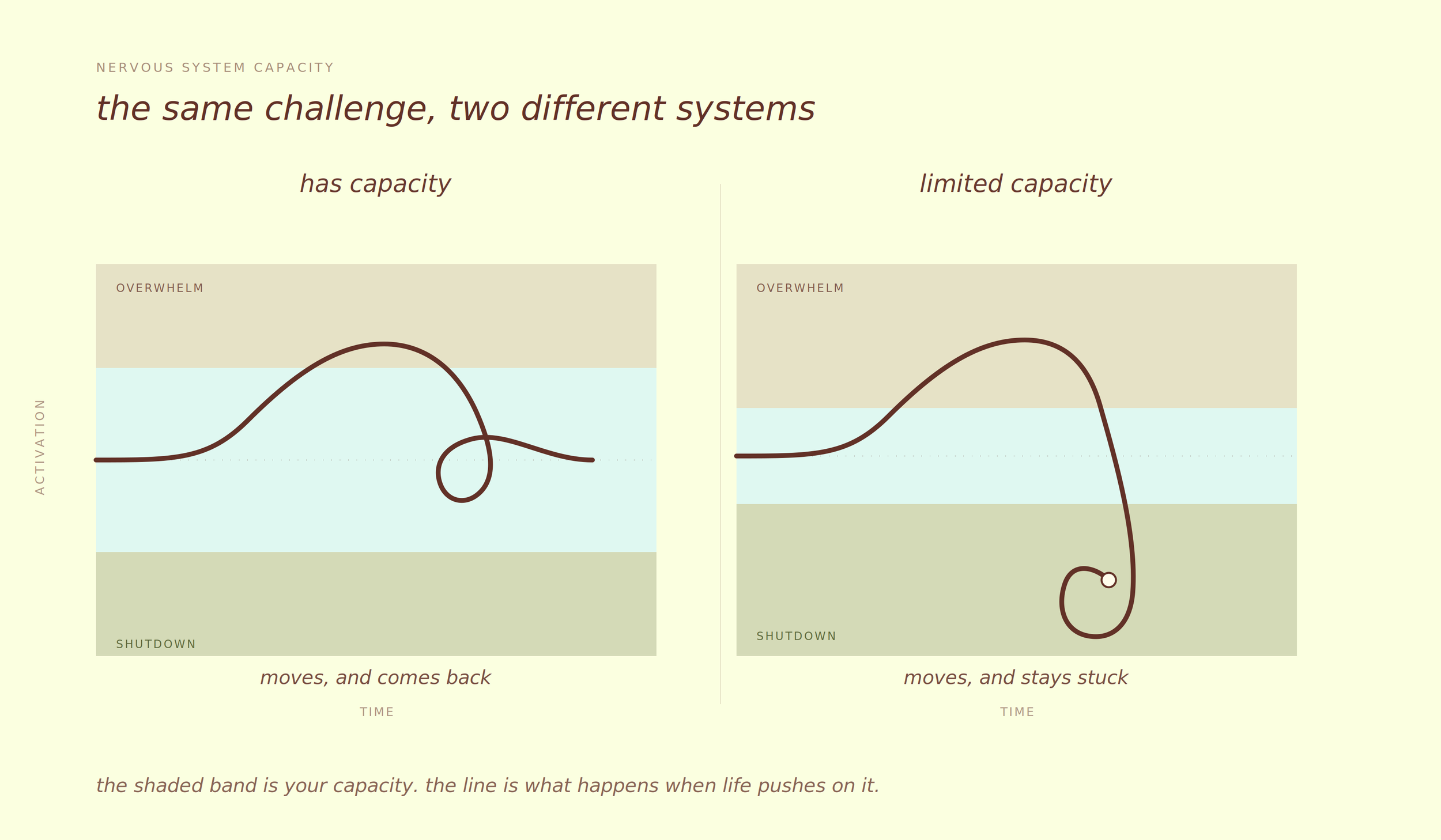
Tension, shutdown, overthinking, and checking out aren't flaws.
All of it protected you once. With more room, it stops being the only option available.
To feel regulated definitely doesn’t mean feeling calm all the time.
never getting overwhelmed
never reacting
never getting knocked off centre
If that’s the bar, no one is regulated, not even the people who look like they are.
‘‘You can completely understand why you have anxiety or a defense mechanism, but your body still reacts on autopilot.’’ Bessel van der Kolk
Questions people ask
-
People living with chronic stress, anxiety, or a system that won't switch off
People who've done a lot of talking therapy, and still feel the weight in the body
People wanting to understand why the same patterns keep arriving in symptoms, in relationships, and in cycles
People whose nervous systems are either over-firing or running on empty
People looking for work that takes the body seriously alongside the mind
You experience chronic physical symptoms (chronic pain, IBS, fatigue) and your medical tests are all clear
People who are curious to learn more about themselves and to go deeper
-
This work sits at the intersection of somatic coaching and functional nutrition. Stress doesn't just live in the mind it shapes hormones, digestion, immune function, and energy. Where it feels useful, we look at how the body is functioning as a whole, and use food and daily rhythm as gentle anchors alongside nervous system support.
-
No. Somatic coaching is not therapy and is not a replacement for clinical or medical care. As a somatic practitioner our work is client-led, present-focused, and orientated around your growth and capacity, rather than clinical diagnosis or treatment. That said, somatic coaching works beautifully alongside therapy or psychiatric support, and many of my clients come with an existing therapeutic relationship. If you're unsure whether this is the right fit, feel free to get in touch before booking.
-
It varies. Some sessions bring noticeable relief right away. Others are quieter, building the safety and capacity that later sessions rely on. Most people find the value is cumulative rather than instant, so we'll keep checking in on what's shifting for you.
-
There's talking, but the focus is on what's happening in your body while we talk, not just the content of what you're saying. That might mean noticing sensation, slowing down a reaction, or working with something small before it builds. You don't need to perform insight, just notice what's actually there.
-
Somatic experience (often shortened to “SP”) refers to the practice of tuning into, noticing, and working with the body’s felt sensations, movements, and internal signals as a way to understand and shift mental, emotional, or behavioral patterns. It emphasizes the body’s pre‑verbal, interoceptive information (such as tension, breath, posture, temperature, or subtle shifts) and uses that awareness to inform coaching, therapy, or personal growth, helping people access underlying states that may not be fully captured by words alone.
-
No, most people arrive with no background in this at all. You don't need the language for what's happening in your body before we start, that's part of what we build together.
-
Looking at how what you eat, when you eat, and your specific nutrient picture support or undermine your body's capacity to regulate, recover, and feel like itself.
In practice, that means working with:
Blood sugar steadiness as nervous system support every dip triggers cortisol, which keeps the system activated.
Specific nutrients that affect regulation
The gut-brain axis how the microbiome produces neurotransmitters and how gut inflammation drives anxiety and low mood.
Anti-inflammatory eating. because chronic low-grade inflammation is one of the things that keeps the nervous system stuck.
Meal timing and the cortisol curve when you eat affects rhythm.
Hormone-aware eating for women, different needs across the cycle's follicular and luteal phases. For men, supporting testosterone through blood sugar steadiness, deep sleep, and the cortisol-testosterone trade-off (both are made from the same precursor, so chronic stress quietly depletes testosterone).
Food as co-regulator, not just fuel eating as a parasympathetic act, when done slowly and in connection.
-
this isn’t energy work, it isn’t spiritual in that sense at all. We’re working with your nervous system - the same system that controls your heart rate, your digestion, your stress response. All very measurable, very real. Nothing esoteric. Think of it more like physiotherapy, but for your stress response rather than a muscle.
-
No. We work with what's happening in your body now. You never have to narrate your history in detail for this work to be effective.
-
That's very common and it isn't a problem. Numbness and disconnection are information too, and building the ability to sense is part of the work rather than a prerequisite for it.
-
No. This practice doesn't include functional testing or supplement protocols. Where food is relevant, it's simple and practical.
Not sure if this is right for you?
Book a free 15 minute chat. No pressure, just a conversation about what you're experiencing and whether this is a fit.